
The bugs on the south wall are not a housekeeping problem
Every fall across rural Northeast Wisconsin it happens on the same schedule. The nights turn cool, a warm afternoon follows, and suddenly the south and west walls of the house are alive with insects — sluggish dark flies basking in the sun, red-and-black bugs stacked in the corners of the siding, orange beetles working along the window trim, and here and there a big, clumsy, leaf-legged bug buzzing against the glass. A few weeks later they are inside, tapping at the windows. Then, on the one warm day in February when nobody expects a bug in the house, they are back again.
This is the fall-invader complex, and it is the defining pest problem of homes in this part of the state. The single most important thing to understand about it is that these insects have nothing to do with how clean your house is. They do not come from your kitchen or your garbage. They come from the land around the house — the lawn, the fields, the woodlot, the trees in the yard — and they are all after the same thing: a warm, dry, protected place to wait out a Wisconsin winter. Your home, sitting warm and prominent on an open landscape, is the best cave for a mile in every direction.
That distinction points straight at the fix. You cannot clean your way out of fall invaders, and you cannot spray your way out of them once they are indoors. What actually works is stopping them on the outside of the building in early fall and sealing the gaps they use to get in. BugBoss The X-Terminator runs this work across the farmhouses, village homes, and lake cabins of Waupaca, Shawano, Outagamie, Waushara, Brown, and Winnebago counties, out of our shop at 600 S. Main St. in Clintonville. This page lays out the whole complex — what each insect is, why they behave the way they do, why the local building stock gets hit so hard, and exactly what we do about it. For an even deeper dive into the behavior and biology, our fall invaders guide covers the cycle month by month; this page is about the service.
Meet the five fall invaders
Five insects make up the bulk of the problem here. They are unrelated to one another — flies, true bugs, and beetles — but the Wisconsin climate has pushed them all into the same survival strategy, so they arrive together and get handled together. Knowing what each one is helps you understand why they all end up in your walls.
Cluster flies
Cluster flies are the ones people misunderstand most, because they look enough like house flies to be mistaken for a sanitation problem when they are nothing of the sort. They are a bit larger and darker than a house fly, with a distinctive patch of short golden hairs on the thorax and a slow, clumsy way of flying and crawling. The name comes from their habit of gathering in clusters in sheltered spots.
Here is the part that surprises people: cluster fly larvae are parasites of earthworms. The adult female lays her eggs in the soil, the larvae find and burrow into earthworms, and they develop inside the worm before emerging as adults, usually over a couple of generations across the summer. What that means for you is blunt and unavoidable — if your house is surrounded by lawn, pasture, garden, or field, the soil under all of it is quietly producing cluster flies, and no amount of housekeeping changes that. A brand-new farmhouse on five acres of lawn will get cluster flies. It is about the earthworm habitat around the building, full stop. Because seasonal cabins are so often tucked into worm-rich wooded and lakeside ground, they are prime cluster fly territory, which is why the cluster fly control guide leans so heavily on them.
Boxelder bugs
Boxelder bugs are the flat, roughly half-inch, black bugs marked with red or orange lines that stack up by the hundreds on warm walls. Through the summer they feed mainly on the seeds of boxelder, maple, and ash trees. A female, seed-bearing boxelder tree near the house is a classic source, but they will travel from trees a good distance away, so having no boxelder in your own yard is no guarantee. They do not bite, they do not sting, they do not breed indoors, and they do not damage the structure. The nuisance is the numbers and the mess: their droppings stain light-colored siding, curtains, and blinds, and crushed bugs smell bad and leave a reddish stain that is a chore to clean.
Asian lady beetles
Asian lady beetles look like the familiar ladybug but behave nothing like the harmless native ones people remember from childhood. They range from yellow to deep orange, usually with a variable number of black spots and a small M-shaped or W-shaped marking behind the head that is the surest way to tell them apart. Introduced to North America to control crop aphids, they have become one of the Midwest’s most aggressive overwintering invaders. Unlike native ladybugs, they can deliver a small, startling nip, and when disturbed or crushed they release a foul yellow fluid that stains surfaces and, in large indoor numbers, can trigger allergy and asthma reactions in sensitive people. They gather in enormous numbers on sunny, light-colored walls on the first cool, bright days of fall, then push into the structure.
Brown marmorated stink bugs
Brown marmorated stink bugs are the newest widespread member of the club. Shield-shaped, mottled brown, and a bit over half an inch long, with banded antennae and a banded edge to the abdomen, this introduced bug has been spreading steadily through Wisconsin. It follows the fall-invader playbook exactly — mass on warm south and west walls, slip into wall voids to overwinter, and reappear indoors on warm days — and it lives up to its name when disturbed or crushed, giving off a strong, cilantro-and-skunk odor. It is not yet as universal here as cluster flies, but it is climbing every year, and the same exterior-treatment-plus-sealing strategy covers it.
Western conifer seed bugs
Western conifer seed bugs are the biggest and, to many homeowners, the most alarming of the group. Long, brownish, and leaf-footed — with flattened, leaf-shaped flares on the hind legs — they are tied to conifers, feeding on the seeds and cones of pines and spruces through the summer. Homes and cabins with evergreens nearby produce local populations that move indoors to overwinter as the weather cools. They are completely harmless: they do not bite, sting, or damage the home, and they do not breed indoors. But they are large, and they fly with a loud, clumsy buzz that startles people, and they are frequently mistaken for stink bugs or even for the kissing bug, which does not establish in Wisconsin homes at all. The fear they cause is out of all proportion to the actual (zero) threat, but the entry pattern — and the fix — is identical to the rest of the complex.
Why they all do the same thing at the same time
These five insects are not related, but the Wisconsin winter has forced them into one shared strategy: overwintering as adults inside sheltered structures. Understanding the mechanics of that strategy is what lets you interrupt it, because every part of the BugBoss approach targets a specific step in the cycle.
As late summer turns to fall and the days shorten, all of these insects stop reproducing and switch into overwintering mode. This is a hard, hormonal change triggered by shortening daylight and cooling nights, not a casual drift indoors. They begin seeking a place to spend the winter, and they are drawn to large, sun-warmed, vertical surfaces — which describes the south and west walls of your house perfectly. On a bright fall afternoon those walls can be many degrees warmer than the surrounding air, and the insects pile onto them by the hundreds or thousands, basking in the warmth and then probing every crack and seam for a way inside.
That gathering behavior in September and October is the critical window. While the insects are massed on the outside of the building they are exposed, reachable, and vulnerable to a residual treatment on the walls. Once they filter through the gaps into the wall voids, soffits, and attic, they are none of those things — they are sealed inside the structure where nothing reaches them.
Once inside, they settle into diapause, a dormant, suspended state that carries them through the cold months. They do not eat, they do not breed, they do not damage anything — they simply wait. This is worth emphasizing because it is the source of endless confusion: fall invaders do not build up a population inside your house the way mice or cockroaches do. The number that entered in October is the number you have. The trouble is that a dormant insect in the wall cannot tell a true spring warm-up from a false one. When a sunny day in January or February heats up the wall cavities, a fraction of the insects rouse, assume winter is over, and start moving toward light and warmth — which, from inside a wall, means the interior. They emerge at windows, light fixtures, and gaps in the trim into your living space. A cold snap the next day sends the survivors back into dormancy, and the cycle repeats on the next warm day, in batches, all the way into spring. Come April and May, the survivors that stayed hidden try to get back out to the landscape to breed, producing a second round of insects at the windows that people mistake for yet another new infestation. It is all one population, one cycle, cued by the seasons.
The timing is the whole game
If there is one thing to take away from all of this, it is that fall-invader control is a timing problem before it is anything else. The insects are only reachable, and the building is only defensible, during a narrow window in the fall.
The treatment has to go down while the insects are still on the outside of the building. Treat the exterior walls in late August or September, as the insects begin to arrive and mass, and the residual barrier catches the wave as it lands — knocking the insects down before they reach the voids. Wait until October, when they are already slipping into the walls, and you have missed most of them. Wait until they are overwintering inside and there is no effective treatment at all; you are reduced to vacuuming what appears at the windows and trying again next year. This is why we push so hard on early scheduling: the difference between a treatment in early September and one in late October is the difference between a quiet winter and a house full of bugs.
The flip side of that timing is why the insects come back in late winter and early spring, and it is worth understanding because it changes how you should react. When they reappear at your windows on a warm February day, it is tempting to conclude the fall treatment failed or that a new invasion has started. Neither is true. Those are the insects that got in before the treatment, or through a gap that wasn’t sealed, waking from diapause on schedule. The right response is not to panic and spray — it is to vacuum them up, note that the building needs a stronger exterior treatment and more sealing next fall, and get on the schedule for late summer. The winter comebacks are a symptom of last fall’s entry, not a live problem you can treat your way out of in January.
How they get into the local building stock
Fall invaders exploit the same building weaknesses over and over, and the housing stock around Clintonville offers a lot of them. Knowing where they get in is what makes both the sealing and the treatment effective, because no two houses leak in exactly the same places.
The classic entry points are up high and along the seams: the junction where the soffit meets the fascia, gaps around window and door frames, the space behind loose or aging trim, gaps at the roofline and where the roof meets the wall, utility and pipe penetrations, dryer and bath vents, weep holes, and the cracks where siding meets the foundation. The insects work their way along a wall probing every one of these, and it only takes a gap the width of a pencil lead for a cluster fly or a lady beetle to slip through. Because they gather on the sunny south and west walls, those exposures leak the most insects even when the gaps are no bigger than on the shaded sides.
The older homes common across this area make the problem worse in a specific way. Many pre-war and early-1900s farmhouses are balloon-framed, meaning the wall studs run in one uninterrupted length from the foundation sill plate straight up to the attic, with no fire-stops between floors. That construction turns the wall cavity into an open vertical highway. An insect that squeezes in low on the wall near the foundation has a clear shot all the way up to the top of the house, which is why you find cluster flies at a second-floor bedroom window when the entry point was a gap down near the sill. It is the very same feature that lets mice travel a farmhouse wall from the basement to the attic — the insects and the rodents are using the same open cavities, which is one reason fall really is both bug season and mouse season at once, and why a thorough fall inspection looks at both.
Then there is the simple matter of scale. Rural homes tend to have big walls — tall, two-story farmhouses with large, light-colored south and west faces that bake in the fall sun and present a huge warm surface for the insects to orient to. A pale, tall farmhouse standing alone on open ground, facing a harvested field or a woodlot, is close to a worst-case magnet. Seasonal cabins are a category of their own: tucked into wooded and lakeside settings that produce heavy cluster fly and seed bug populations, and left closed and undisturbed all winter, they let overwintering insects settle in completely unbothered. Village homes in Clintonville proper are generally tighter but still have the usual weak points at the soffits, windows, and utility lines. Wherever the building sits, the pattern of entry is the same, and finding your building’s specific gaps is a core part of the job.
A nuisance, not a danger — but a real nuisance
It is worth being clear-eyed about what fall invaders do and do not do, because the honest answer cuts both ways. On the harm side, they are close to harmless. None of the five breed indoors, so they never multiply inside the walls — what gets in is what you have. They do not feed on your food, your fabric, or your house, so they cause no structural damage the way carpenter ants or mice do. They do not spread disease. With the mild exception of the Asian lady beetle’s small nip, they do not bite or sting. If a bug landing on the window in February is your worst pest problem, you are, in the grand scheme, lucky.
But the nuisance is genuine, and in a heavy year it is more than most people expect. The sheer numbers are the first issue — hundreds or thousands of insects on a wall, and dozens appearing indoors on every warm day for months, wear on anyone. Then there is the mess. Boxelder bugs and cluster flies leave fecal spots that stain light-colored siding, curtains, blinds, and painted trim. Asian lady beetles bleed a yellow, foul-smelling defensive fluid that marks walls and fixtures and can provoke allergy and asthma reactions when large numbers overwinter in a home. Brown marmorated stink bugs and seed bugs release a strong odor when disturbed or crushed. And there is a secondary-pest angle that homeowners rarely anticipate: large accumulations of dead insects in wall voids and attics become a food source for other pests — carpet beetles and the like — that feed on the carcasses, so a bad fall-invader problem can quietly seed a different problem later. None of this is dangerous, but a house overrun every winter is a house that needs a real solution, not one that should be told to just live with it.
Why interior spraying is the wrong tool
When people first hit this problem, the instinct is to reach for a can and spray the bugs they see indoors. It is the wrong move, for three concrete reasons, and understanding why is what points toward the approach that actually works.
First, the insects at the window are a tiny fraction of the population. For every fly on the glass there may be hundreds tucked into the wall voids and attic where no indoor spray can reach. You can empty an aerosol can on every warm day all winter and never make a dent in the reservoir behind the drywall, because you are killing the handful that emerged, not the mass that stayed hidden. Second, interior spraying puts pesticide exactly where you least want it — in the living space, on the windowsills and around the light fixtures where your family spends its time — to kill a nuisance insect that is not breeding, biting, feeding, or contaminating anything indoors. It is chemical exposure with almost no payoff. Third, it does nothing about next year. The building will attract the same insects again next fall no matter what you sprayed inside this winter, because the treatment never touched the outside of the building where the decisive battle happens.
The right response to the bugs already inside is mechanical, not chemical: vacuum them up. A vacuum removes them without crushing — which matters, because crushed lady beetles, boxelder bugs, and stink bugs stain and stink — and you simply empty the canister afterward. But vacuuming is cleanup, not control. The actual control happens outside, months earlier, and that is where the BugBoss process is aimed.
The BugBoss process: exterior treatment plus exclusion
Breaking the fall-invader cycle takes two coordinated moves, done in the fall, on the outside of the building. We run it the same disciplined way every time.
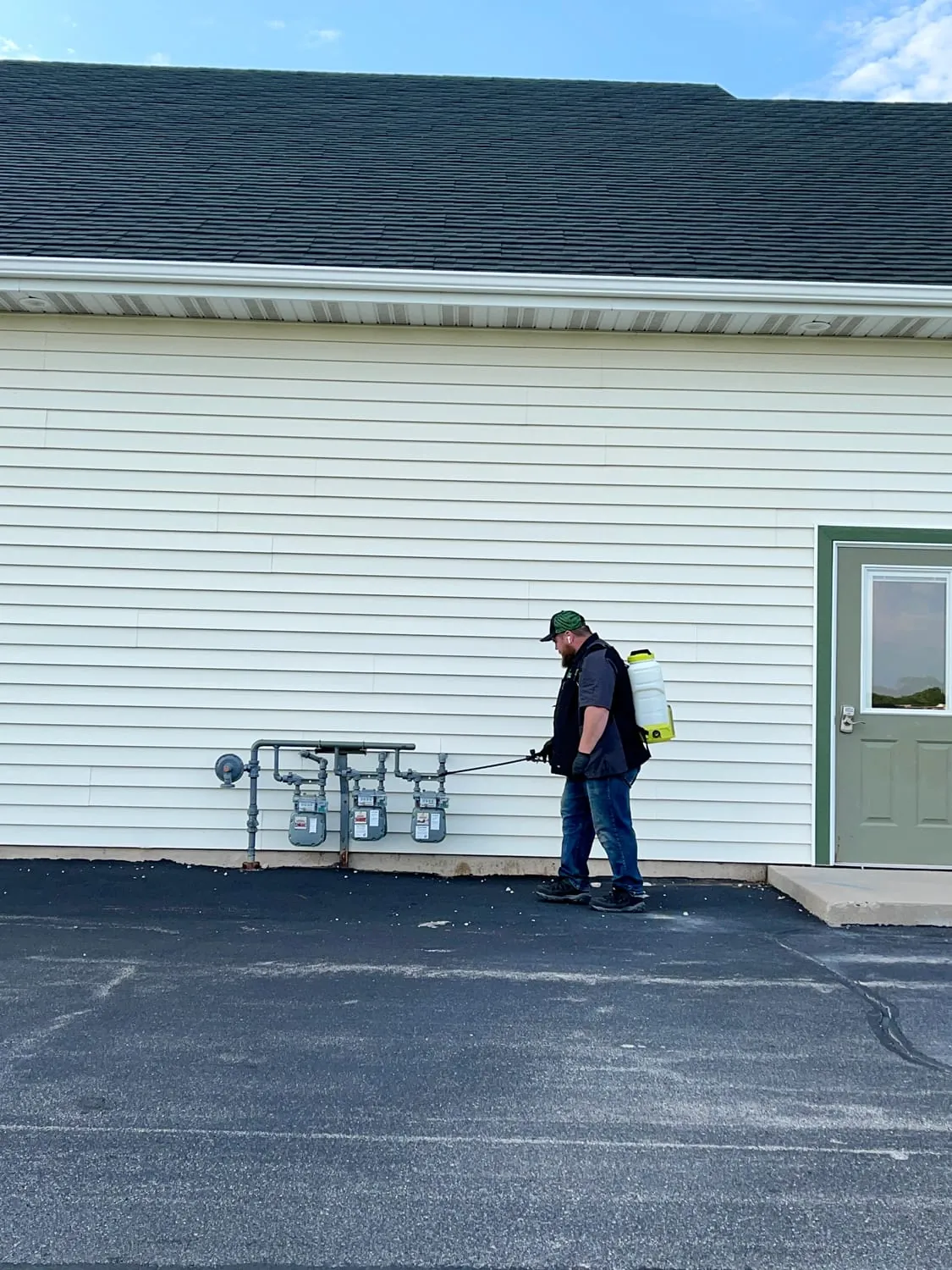
The centerpiece is an early-fall exterior treatment. In late summer and early fall, before the insects mass, we apply a residual product to the surfaces where they gather and probe for entry — the sunny south and west walls, the eaves, the soffits and fascia, and the areas around windows, doors, and other openings. When the insects land on those treated surfaces during their fall arrival, the barrier knocks them down before they get inside. The timing is non-negotiable, and it is the single biggest factor in how well the season goes: treat while the insects are still outside and you catch the wave; treat too late and you have missed it. We focus the effort where it counts — the warm walls and the roofline seams — rather than blanketing the whole property, because that is where the insects actually concentrate.
The second move is exclusion — physically sealing the gaps the insects use to get in. This is the part that pays off for years rather than a single season. We inspect the building for the entry points specific to your construction and seal what matters most: the soffit-and-fascia junctions, the gaps around window and door frames, utility and pipe penetrations, vents, roofline gaps, and the cracks where siding meets foundation. On balloon-framed farmhouses, closing off the tops and bottoms of those open wall cavities makes a real difference to both insects and rodents. No older home can be made perfectly tight — you will never find and close every gap on a century-old farmhouse — which is exactly why sealing is paired with the exterior treatment rather than relied on alone. The treatment thins out the wave that arrives; the sealing shuts the doors it is trying to come through. Together they attack the problem from both directions, and a house that was overrun every winter becomes one where a stray bug at the window is a rarity.
For homes that already have insects overwintering in the walls when we get the call, we are straight about what is realistic: we knock down and vacuum out what is accessible, seal to stop more from entering, and set up the properly timed exterior treatment for the following fall that finally breaks the cycle. We would rather tell you honestly that the real win comes next September than sell you a winter treatment that cannot reach insects sealed in the walls. Everything runs through our residential pest control service, and fall-invader work often pairs naturally with a broader general pest control visit and with the rodent exclusion the same season demands.
Annual programs for the homes that get hit every year
Some homes get fall invaders once and, after a good treatment and thorough sealing, largely stay quiet. Others get them every single year no matter what, and it is worth understanding why before deciding on a program. These insects orient to the same warm, prominent buildings each fall, and the overwintering species leave chemical cues that draw the next generation back to a proven site. A house that got them last year is very likely to get them again, especially the tall, pale farmhouse on open ground that sits in a heavy local population. For those homes, a one-and-done treatment is not the honest recommendation.
That is why we offer an annual early-fall program — a properly timed exterior treatment each year, with sealing maintained and extended over successive seasons. The first year’s sealing closes the biggest and most obvious gaps; subsequent years let us catch the ones that turn up as an old building keeps settling, so the exclusion gets stronger over time while the yearly treatment keeps the arriving wave knocked down. Crucially, an annual program with BugBoss is not a contract. We do not use long-term contracts or cancellation fees, and every quote is free and up front. You choose each year whether to continue, based on whether it is working for you, and you deal directly with the owner rather than a national call center. For a big rural wall facing an open field, a standing early-fall visit is simply the most cost-effective way to stay ahead of a problem that comes back on the calendar like clockwork — and it lets us fold in the rodent exclusion that the same fall season calls for. You can read more about the guarantee behind that work on our guarantee page and about our approach to no contracts.
Seasonal cabins and the empty-house advantage the bugs enjoy
Seasonal cabins deserve their own mention, because they are both the most classic fall-invader cases we see and the ones where timing matters most. A cabin on a wooded lot or a lakeshore sits in exactly the habitat that produces the heaviest cluster fly and conifer seed bug pressure — worm-rich soil, mature trees, and stands of pine and spruce all within a stone’s throw. Then it gets closed up in the fall and left quiet and undisturbed for months, which is the ideal situation from an overwintering insect’s point of view: a warm, prominent building nobody is around to bother them in. Owners who close up in October and return in spring routinely find windowsills and light fixtures full of dead flies and beetles and clusters waking in the walls.
The fix for a cabin is the same exterior treatment and sealing, timed to the closing schedule rather than to a regular occupied-home rhythm. We treat and seal before or around the time you close the property, so the building is protected through the exact months the insects are trying to move in and settle for the winter. That means far fewer insects to sweep up when you open in spring and far fewer clusters cycling out of the walls on warm days. Because cabins around Iola, Manawa, the Chain O’ Lakes, and the Wolf River also draw the mice and other pests that exploit a vacant building, we handle the whole seasonal picture together; it is covered in depth in our cabin seasonal pest control guide.
When to call BugBoss
Call in late summer or very early fall if you have had fall invaders before — this is the single most important thing you can do, because it is the only time the exterior treatment decisively works. If you got bugs on the south wall last September or found flies at the windows last February, do not wait for it to happen again; get on the schedule for August or early September so the treatment goes down before the wave arrives. Call before you close up a seasonal cabin, so the building is protected while it sits empty. And call even if it is already fall or winter and the bugs are inside — we will tell you honestly what is worth doing right now versus what should wait for the fall window, seal what we can to keep more out, and set up the properly timed treatment that ends the cycle going forward.
Here is where a local company earns its keep. Fall-invader control is a timing-and-building problem, not a product you spray on a fixed quarterly route. It takes someone who will get on a ladder in early fall, read your specific building’s warm walls and leak points, treat at the right moment, and seal the gaps that matter — and who will be straight with you about what is realistic in January versus what has to wait for August. The national brands dispatched from the Fox Valley are built for volume and recurring contracts, not for this kind of timed, hands-on, honest work. BugBoss is family-owned, founded in 2021 by Brian and Amber Zahringer, based right here at 600 S. Main St. in Clintonville, licensed and insured, with no contracts and free up-front quotes. We handle the whole fall-invader complex — cluster flies, boxelder bugs, Asian lady beetles, brown marmorated stink bugs, and western conifer seed bugs — along with the mice and spiders that push in on the same fall schedule, across Waupaca, Shawano, Outagamie, Waushara, Brown, and Winnebago counties.
If your house or cabin fills up with fall invaders every autumn — or every warm winter day — the time to act is late summer, not the first sunny afternoon in February. Call BugBoss at 866-BUGBOSS (866-284-2677), or request a free quote, and we will get the exterior treated and the building sealed before the next wave arrives. Local, licensed, no contract — and the bugs stopped on the outside where it actually works. You can browse the whole pest library for more on any of the insects above.